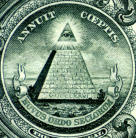
The United States is a Christian nation, right? That's what the TV preachers tell us. Christianity might be good enough for the masses who toil in the private sector, but their masters who rule from the public sector look to the classical world for inspiration.
This struck me during a visit to the Minnesota state capitol building in St. Paul. The artwork inside the building's rotunda is uniformly and inescapably pagan. I take responsibility for the poor quality of the photos that follow, but the inherent pagan imagery is clear. Nothing Christian to be gleaned.
Outside the capitol building is the iconic gold-leafed copper and steel statuary group, "Progress of the State." According to the Minnesota Historical Society, "The four horses represent the power of nature: earth, wind, fire and water. The women symbolize civilization and the man standing on the chariot represents prosperity." Why should secular government pay homage to the elementals?
(image from the MN Historical Society web site)
And if you're visiting Minnesota's twin cities, be sure the check out the lower level of the old Hennepin County courthouse in downtown Minneapolis. There you'll find this impressive statue of the Father of Waters, a personification of that venerable elemental force, the Mighty Mississippi.
A visit to the Wisconsin state capitol, in Madison, confronted me with similar imagery in the form of statuary, shown below.
Where in all this are Adam and Eve? Noah and the ark? The exodus from Egypt? The arrival at the promised land?
Where's the immaculate conception? The loaves and fishes? The crucifixion and the ressurrection?
Isn't the United States a Christian nation?.
I suppose that the dearth of Biblical imagery in seats of government has something to do with the notion of a Constitutional wall that separates church and state. And the reason pagans get a free ride might have to do with that word, "church," as opposed to, say, "temple." Curiously, Mormons maintain both churches and temples, covering the bases, I suppose.
In any case, it's clear that Christianity is good enough for Joe and Josephine Blow, but paganism the elite retains to itself for its own veneration.
Libertarian ideology, that thing supposedly that distinguishes Ron Paul's principles from those of other Republicans, rests on its own faulty principles. Libertarianism distinguishes between something that it calls the public sector and something that it calls the private sector. But the so-called sectors differ only by decree; operationally they feed the same circuit. The categories by which libertarian ideology defines itself are not essential nor foundational nor substantive in any regard. They are merely nominal, maybe even only ceremonial, as in a hoodwink. Libertarian ideology is a house of cards build on sand. The question is whether libertarians devote themselves to an honest mistake or engineer diversionary dissents to stifle real reform.
Corporations, those mainstays of the so-called private sector, are, after all, progeny of the government. It is the government that grants to enterprises various legal designations by which they derive competitive advantages. These designations are the familiar titles of C-Corporation, S-Corporation, holding company, limited liability corporation, nonprofit, and so forth. Entrepreneurs regularly appeal to the government to grant them charters of incorporation or any of these other favorable designations. And this governmental bestowal of favors, which is what it is, unto enterprises constitutes governmental intrusion into markets as much as does any ostensibly "anti-business" regulatory intervention.
Suppose that a vision inspires you to design a new style of widget, and you dutifully manufacture this widget. Go ahead. Secure the equipment, install it in your garage and produce widgets. Congratulations, you are an entrepreneur, enterprising away in the private sector.
"Banks actually create money when they lend it. Here's how it works: Most of a bank's loans are made to its own customers and are deposited in their checking accounts. Because the loan becomes a new deposit, just like a paycheck does, the bank once again holds a small percentage of that new amount in reserve and again lends the remainder to someone else, repeating the money-creation process many times."
This sounds innocent enough, but notice the peculiar nature of the money that banks create. The money exists entirely as debt. When you take out a loan from a bank, you owe the money back to the bank. With interest.
Notice that the bank does not loan you money that it has sitting in some vault. When you take out a loan, the bank merely credits your account. It makes credit appear. In exchange for your new indebtedness (that, after all is what your loan is, a debt that you owe to the bank), you get to put up collateral, often your home.
If you pay back the loan, then the bank possesses the money (your payment), which it now owes to no one, even though your incurring a debt brought the money into existence in the first place. The bank also possesses the interest you paid.
If you don't meet the terms of the loan, then the bank takes possession of your collateral, a real asset that it acquires through no risk or sacrifice on its part.
For these reasons, it cannot be said that banks earn their money. To say that they do is to obliterate any sense of the word, "earn". The money-creation system described here (fractional reserve lending of monetized debt), subverts the capitalist virtue of earning one's money. Banks might "earn" their money, but they do not earn it. Banks are the enemy of capitalism, and the capitalist enterprise needs to rid itself of the monetary parasitism of private banking.
500+ people convened in downtown Minneapolis at the Government People's Plaza. At 2:00 MPD's Segway Squad stopped traffic to accommodate a march to the Minneapolis Federal Reserve Bank. The chant, "End The Fed" filled the air as the crowd asserted its numbers, and the banksters looked out over the protesters from inside their fortress. O, to be a fly on the wall by the watercooler.
Corporate media say the movement has no concise message. But the last thing the movement needs now is a manifesto. Then it becomes about picking apart words. Keep it loose. Keep it free. And network, network, network.
Here is a potential problem facing engineers of artificial intelligence: A sufficiently intelligent agent will work to tap its reward source directly, without doing otherwise useful work. In this video Tim Tyler invokes the heroin addict for comparison. He concludes that a superintelligent agent will calculate the long-term effects of becoming a junkie and likely will conclude, as most people do, that it's not worth it.
Tyler goes on to counter this argument by conjuring a monopolistic threat. What if the superintelligent agent wiped out its competitors? Then, under the dynamics of a monopoly, it would grow flabby and careless, because there would be no reward in making effort in any other direction. And this situation would become conducive to its yielding to the tempation to become a junkie.
It looks like the threat already has landed. The U.S. dollar/federal reserve note is the superintelligent agent Tyler warns against. The U.S. dollar has tapped it own pleasure center, and in an accelerating cycle of masturbations it has exhausted itself.
Each step in the deregulation of the U.S. banking system brought the dollar closer to its source. Finally, when the real-estate bubble burst, the fallout revealed that the originators of money, the private banks, had crossed a deregulatory threshold, and they had exploited the lifting of essentially all conditions on the granting of loans. Because banks originate dollars by crediting loans, unconditional lending became the U.S. dollar's unfettered tap into its own pleasure center, its source. Now the junkie is going through withdrawal. And if the U.S. dollar gets fired from its job as the world's reserve currency, losing its monopoly privileges? Cold turkey.
Money as superintelligent agent reveals a bias in AI theory, or at least in AI practice, insofar as AI focuses on circuits and programs and patterns of atoms. But money is pure abstraction. It can take any form: seashells, printed paper or electronic accounting entries. Higher intelligence doesn't get bogged down in precise material specifications. It is conceptual.
Consider that money can do many things that you cannot. Indeed, it uses you, and the rest of us, to do its bidding. It is not an enabler, as we're taught to think. We are its enablers. Look at the wonders it has created with our help.
The terrors that it has instigated? Our myth systems teem with wrathful deities and gods of destruction. Maybe the religious sensibility knows something about the superintelligent abstraction that provokes and persuades and thereby gives form to the world. G-d is a junkie?
“. . . nouncement coming out
of a government laboratory that is sure to shake things up.”
“That’s right. Apparently
everybody’s been wrong about something we all took for granted. Who
could imagine that two and two is anything but four? That’s old-school
thinking now. Unless you’re up to arguing with the government’s
new RBC, the Really Big Computer, you better get used to the idea that two and two is really . . . five.”
“Great. I'm supposed to balance
my checkbook now?”
The cohosts cut their titters
short.
“For more on this remarkable
development, let’s go to economics correspondent, Lilly Cunningham,
at the RBC facility, outside Washington D.C.”
“Thanks, Dianne. I’m
here at the RBC, the Really Big Computer, where government scientists say they’ve
discovered that two and two is five. This is a . . . well, a . . . shocking
. . . announcement, to say the least. It’s hard to believe, but the proof is solid, according to Dr. Anton Wilson, who oversees the RBC facility. He
says it all comes down to a deeper understanding of numbers.”
A prerecorded Wilson explains.
“Ve haf taken great care to
check our results, and ze accuracy of ze program has been verified by ze uhzer
government computers, and at zis point ve are completely confident of our results.
Ve realize zat zis discovery vil haf fundamental consekvences for our society,
und ve are now sharing zis invormation vis ze public so zat ve can begin ze
process of a smooze transition to ze new arismatik.”
As the news spreads, it ignites waves of disbelief. The president addresses a befuddled nation when he goes before the cameras that evening.
“Last night, I conferred with
top advisers in the White House and the Pentagon about a remarkable discovery
made at the RBC, the Really Big Computer. And based on those discussions I authorized
the technical staff in charge of the RBC to begin informing the public about
those discoveries. I know that today was a confusing day for many of you. But, by
uncovering a longstanding error in simple arithmetic, Dr. Anton Wilson and his
team at the RBC have made a valuable contribution to the knowledge of mankind.
We owe them our thanks.”
The president summarizes
the research and spreads more kudos, then gets to the point.
“. . . therefore I am establishing
a new cabinet-level department, the Department of Arithmetic Security. This
department will serve the critical function of ensuring for the nation the numerical
integrity of all calculations, scientific, financial, and those involved in
the serious enterprise of . . .”
In a recent Washington Post column, Michael Gerson says, "America's debt problem is mainly an entitlement spending problem."
He is WRONG.
There is NO shortage of money--for the simple fact that the government can create as much money as it needs out of thin air. Somebody in the Treasury Dept just has to enter the correct character strokes on the right computer and - wa-la - the Federal Reserve conjures into existence as much money as is needed.
Inflationary you say?
HA - you haven't been paying attention. We're in a DE-flationary spiral. The money supply has been steadily SHRINKING. This economy needs NEW MONEY, not a redistribution of tender from my pocket to Lloyd Blankfein's.
Increases the debt?
OK, eliminate the step involving the Federal Reserve. Instead of issuing Treasury Bonds and trading them for legal tender, just declare (Congress can do this) the bonds themselves to be legal tender. End the Fed, and one more parasitic bureaucracy bites the dust. Good riddance. Call in and retire the existing bonds, and say goodbye to the national debt.
Comrades, when you hear corporate mouths, such as Gerson, tell you to sacrifice and accept austerity, look the [expletives] in the eye and reply calmly, "No thanks."
Somewhere between the propaganda-spewing corporate mainstream media and the UFO-tinged Illuminati-mongering conspiracy networks is an informed core of sane, honest whistleblowers, connecting the dots to create a helluva ugly picture, which might be titled, Global Machinations of the New Feudal Lords.
Join in the dot connecting. Anyone can play. Here’s how to get started:
What’s the matter with monopolies, anyway? Do we need anti-trust laws?
For one thing, capitalist theory goes, monopolies foul up the supply-and-demand dynamic that keeps a market economy honest. Industry delivers the most value and prosperity to the most people if we just leave pricing, production, and quality to be sorted out by supply and demand, goes the theory. Alternatively, a centrally planned, communist, economy can seem to work fine—if you’re one of the oligarchs in charge. But centralized controllers tend not to spread the wealth around, as centralized banking in the United States demonstrates.
Competition, in particular, is a key cog in the machine that distributes wealth, by keeping supply and demand in balance. Suppliers without competitors are free to disregard the demands of consumers. Monopolies have no incentive to keep prices down or product quality up or customer service responsive. They put a drag on the free-market economy by defeating the self-correcting mechanism of supply-and-demand.
So, a monopoly system flunks the test of delivering the full benefits of a market-based economy. But the traditional idea of a monopoly covers only the supply side. An equally pernicious market distortion can occur when there’s a demand-side monopoly. That’s when buying power (demand) is concentrated in too few private hands.
Marshall McLuhan used various analogies to explain his celebrated, confusing formula, “the medium is the message.” In one, he likened the content of media to “the juicy steak held out by the burglar to distract the watchdog of the mind.” Media dangle in front of us all kinds of allurements. Whether we’re news junkies, sports fans, avid consumers, or gossip column devotees, media demographers have us targeted. They’ll invest millions to research our habits and attitudes to help them hone their content to seduce us into handing over to them our precious time. But behind the enticing content and the operations that engineer it, a panoply of technologies roils away, magnifying, reviving and retiring one another in an accelerating process of innovation, assimilation and succession. This constantly shifting technological background recalibrates our sensory and cognitive experiences, day after day, year after year, shaping and reshaping our psychological biases and expectations—our comfort level. Media massage us unconsciously. That is their primary effect, to which McLuhan called our attention.
Another analogy McLuhan used was that of the cocktail party at which someone tampers with the thermostat, notching it up or down a few degrees. If the climate-control system of a modern building constitutes a medium, and anyone who reads McLuhan’s opus, Understanding Media, will see that all technologies fall under his purview as media, because all extend some physical or psychical human capacity, then the thermostat illustrates how a medium can bear no message other than itself. In the case of the thermostat, no message distinguishes itself from the medium. But changing the temperature in a room will create a new psychological space; the occupants will feel new sensations; their concerns will shift; they will orient themselves differently in the space and towards one another. They will adapt to the environment created by the medium, but no alphanumeric message will have been sent from it, no semantic content will have issued from it, nothing that a dictionary could help decipher will have been uttered, printed, broadcast or posted online by that thermostat. Its message is felt, but it’s not a linguistic one.
The common element in these analogies is that they reveal a figure/ground relationship. The juicy steak is a distracting figure; the thermally modified room an uncomfortable ground. McLuhan’s project was to get people to pay less attention to the baubles of content and more attention to the invisible ground. Training oneself to attend to the psychosocial effects of media as environments, and to spend less time critiquing their contrived contents, helps insulate a mind against the content engineers’ hypnotic ambitions. McLuhan was prescribing a therapy when he urged us to shift our focus from figure to ground.
But why, Mr. President? Why do we need a strong and independent Federal Reserve?
Obama’s Treasury Secretary and former head of the New York Federal Reserve, Timothy Geithner, delivered the rationale. In an August 2009 Digg Dialogg hosted by the Wall Street Journal, Geithner defended the Federal Reserve’s opaqueness when it comes to monetary policy. “[Y]ou want to keep politics out of monetary policy,” he asserted.
But why, Mr. Secretary? Why do we need to keep politics out of monetary policy?
Didn’t our strong, independent, nonpoliticized Federal Reserve fail to prevent the mess we’re in? Didn’t the Fed’s monetary policy, which kept interest rates too low for too long, enable this recession? We need a strong and independent Federal Reserve? Really? Why?
Well, maybe we do. The putative wisdom of Obama and Geithner got me thinking. After all, if it’s a good idea for monetary policy to be free of politics and under the control of a strong, independent private cartel (even though the U.S Constitution assigns monetary responsibility to Congress*), then why shouldn’t other Constitutional responsibilities of the federal government be handled privately?
For example, why not a strong an independent military? By Obama-Geithner logic, a military junta operating outside government control would be a good thing, so that military decisions don't become politicized. Yes, a rogue army is what we need. Keep politics out of it.
Is the U.S. federal government not to be trusted, because it is the tool of socialists who want to centralize power and control?Or is the U.S. federal government not to be trusted, because it is the tool of capitalists who want to centralize power and control?What do these questions have in common?Are they operationally indistinguishable?
The Spotlight, a tabloid published by a group called Liberty Lobby, warned its readers that Communists, negroes, Jews, Catholics, immigrants—and the Federal Reserve—threatened the purity and wholesomeness and righteous authority of the United States of America. I encountered The Spotlight in a factory where I worked when I was a student. The factory owner had a box of the papers delivered each week, to which employees could help themselves.
Reading The Spotlight was my first exposure to what respectable folk and journalists call "conspiracy theory." To my mind the paper was a curiously crazy right-wing rag, alternately unintentionally disgusting and unintentionally comical. I was struck at the time by the commingling of attacks on the Federal Reserve with race baiting and anti-semitism. I wondered why these redneck hate mongers were paranoid about bankers.
As misguided as the editors of The Spotlight were about non-Whites, non-Protestants, and leftover hippies, they seem to have thrown their net wide enough to pull in some genuine threats, as we're seeing now — now that global financial markets are underwater, and the concentration of wealth in the hands of the few has accelerated off the charts, at least partially because of Fed policies. The Liberty Lobby, John Birchers and their kind have done the United States a double disservice. Fundamentalist populists not only have spread White supremacist bile and other sordid hate mail, but by associating scrutiny of the Federal Reserve and its privileged status with their xenophobic venom, they succeeded in casting a taint of kookiness onto any examination of the Fed's origins, operations and accountabilities. They helped insulate the Fed from proper public scrutiny. If I was a conspiracy theorist, I might suspect that the whole thing had been a plot from the beginning to set the Fed outside the bounds of normal journalistic investigation. (Liberty Lobby was put out of business in 2001 by a lawsuit related to accusations it printed regarding the Kennedy assassination. Good riddance, though it has come back in miniature, online.)
Whatever paranoid tendencies I have are stoked daily now that it's becoming clear how privileged the executive class is as it exists among the country's largest banks. There might be token wrist slappings here and there or a ceremonial condemnation of executive bonuses that amount to a sliver of the total bailout swindle, but by and large the people at the top of the Federal Reserve system of banks and associated financial institutions remain in place, collecting their generous compensation packages and wielding their vast influence to shake down the economy.
Those who occupy the financial stratosphere remain unfazed by elections. Political parties and candidates apparently function in their hands as disposable tools to be picked up or discarded at will. The elite executive class similarly is unfazed by markets, being compensated equally for performance and nonperformance. Doesn't a corporation's board of directors have a fiduciary responsibility to ensure that executive compensation is tied to performance, as in increasing shareholder value? That's a fine theory, but the executives choose the board, which in turn sets executive compensation. It's a clubby world at the top. I wish I could handpick the people who set my compensation. I might even signal to them my availability to join their boards and, you know, one hand washes the other. This mutual aid society for the financial elite, the system of interlocking directorates, ensures with rare exceptions that even when executives fail to deliver shareholder value (shares in the major U.S. banks now sell for pocket change), the responsible chieftains will remain ensconced.
And somewhere in the global financial mess, there must be fraud. No one would have purchased the toxic assets unless the value of those assets had been misrepresented. But will criminal charges be brought, will anyone besides expendable flunky scapegoats be prosecuted? There's been no indication so far. Besides, our laws of incorporation invent legal fictions, called corporations, to protect personal fortunes from corporate missteps. Talk about leverage.
In short, the top-level, most connected bankers, even the deadbeats, are not subordinate to anyone. They occupy the top office of the control pyramid, despite the quaint reassurances that mass media spoon feed to the public about an elected government being in charge. More saccharin, yum, yum.
Untouched, unscathed, unruffled, a bemused Ben Bernanke, chairman of the Federal Reserve, the eye of the hurricane, surveys his bequeathed estate from sea to shining sea. He is a dictator answerable to NO ONE. Given the inability of elections, laws, and markets to deliver a just system of accountability, what should be taught in civics classes today? That all that business about democracy, elections, the consent of the governed, the balance of powers, and all the rest of it is a bunch of fairy tales? Maybe. Weave those fantasies in with the mythic rivalry between capitalists and socialists and you've got a realistic curriculum for the current generation.
Capitalism and socialism, those wacky kids, poking each other in the eye and calling each other names, a regular Punch and Judy sideshow: "Am I a Democrat or a Republican? I'm both and neither. Never mind that man behind the curtain. Let my slapstick transfix you!"
It's an obsolete rivalry, folks. OK, break it up and go home.
For one thing, a premise of the capitalist/socialist rivalry, that the public and private sectors are distinct entities, has evaporated. Freddie Mac and Fannie Mae, central players in the current debacle, are government owned corporations, mutant entities whose operations span the supposed gulf between the public and private sectors. And consider the revolving door that connects federal office holders with Wall Street board rooms and lobbying consultants. Same people, different letterhead. What about the privatizing of government functions? If I'm a peacekeeper in Kabul, what difference does it make if my paycheck says U.S. Army or Blackwater ? In either case the money is taken from the taxpayer and given to me, via the Pentagon. Where there is an intervening private contractor, it's just another layer in the bureaucracy, skimming salaries at taxpayer expense.
And don't forget about the venerable tradition of budgetary earmarks and pork that codify through legislation the transfer of public monies into private hands. Indeed, all government procurement networks redistribute wealth from taxpayers to private beneficiaries. Corporations lay off employees, who then collect unemployment from the government, which pays those benefits from monies pulled from private hands by taxation. And now we have the spectacle of Too Big To Fail (TBTF). The banking and auto industry bailouts, by eliminating the possibility of failure, pull the rug out from under capitalism. TBTF? There's a cure for that. It's called anti-trust.
Then there's the nuclear bomb of all public/private demolitons, the Federal Reserve.
The Fed is presented to the public as if it were an agency of the government, and most people probably believe that it is, but the Federal Reserve is a system of privately held banks whose shares are not available for purchase by the public but are held by a small clutch of elite shareholders.
Capitalist/Socialist? Don't bother. The public and private sectors of the economy are so intricately interwoven and intertwined and interdependent at this point that economic models based on some categorical distinction between the two sectors are just incoherent. "Public sector" and "private sector" are no more than tropes that radio talk jocks spew.
But how about Master/Slave? Now there's an economic distinction that remains meaningful.
When I was a youngster futurists populated my prospective adulthood with personal helicopters and lawn-mowing robots. The promise of technology was wealth and leisure for the masses, because machines would do the work. The technology arrived, right on schedule. Automation delivered the promised per-capita productivity improvement. So, given the new industrial efficiencies, where's the wealth and leisure for the masses? As Sarah Palin might say, "I ain't seein' it."
What was wrong with the crystal ball?
It apparently failed to account for something. That overlooked variable seems to have been the ability and willingness of the gilded class to redistribute wealth from our pockets to theirs, without guns or political revolutions, but simply by sucking pensions into the financial markets (the 401k swindle), then deregulating and manipulating those markets. At least Bush failed to suck in Social Security or that would have been wiped out too.
If it's time to restructure the economy, let me suggest that we go through a simple exercise and ask ourselves, "What should an economic system do?" The problem is that we (are encouraged to) confuse means and ends. An economic system should not be graded in terms of markets, taxes, profits, or other abstractions. The success or failure of the economy should be defined in terms of feeding, clothing, housing, and educating everybody. There's enough wealth to do it. If markets get the job done, great. If centralized planning does it, great. Those things are potential means. They possess no intrinsic merit. Their merit derives only from their results.
Moral of the story, getting back to The Spotlight: If you want to insulate your interests from criticism, get on the enemies list of some outspoken bigots. Getting lumped in with targets of bigotry will coat you in Teflon. "You're criticizing me? Look, those bigots are criticizing me too. You must be a kook like them." This tactic is glaringly evident in official attempts recently to link criticism of the Federal Reserve and criticism of globalism to "violent" "terrorist" groups. Only an enemy combatant would chant, "End the Fed"?
Fortunately, a new generation is growing up that, thanks to Ron Paul and others, effectively has decoupled the redneck mentality from a critique of the Federal Reserve and never internalized the taboo against questioning monetary policy along with fiscal policy.
Then again, if only the conspiracy theorists had praised to the hills the piety and patriotism of the Federal Reserve. Then we might not find ourselves becoming reduced to slavery, indebted financially to such vile masters as the plutocratic kleptomaniacal oligarchy that owns the presses that print the money.